Producing large industrial vessels requires precision, structural integrity, and highly controlled manufacturing processes. To meet these stringent demands, our production facility relies on advanced automated welding technology. By minimizing the variability associated with manual welding on large-scale projects, we ensure that every seam meets rigorous industry standards.
A key element of this capability is our automated submerged arc welding (SAW) machine. As a central part of our heavy fabrication operations, it enables consistent, high-quality welds on demanding industrial projects. Understanding how this system operates provides insight into the methods we use to support the long-term performance and safety of the vessels we manufacture.
Technical Capabilities of our SAW System
Submerged arc welding is a process where the welding arc is buried beneath a layer of granular flux. This flux shields the molten weld pool from atmospheric contamination, eliminating the need for shielding gas and preventing hazardous sparks or spatter. While the fundamental chemistry of the process is impressive, the true power of our SAW system lies in its automation.
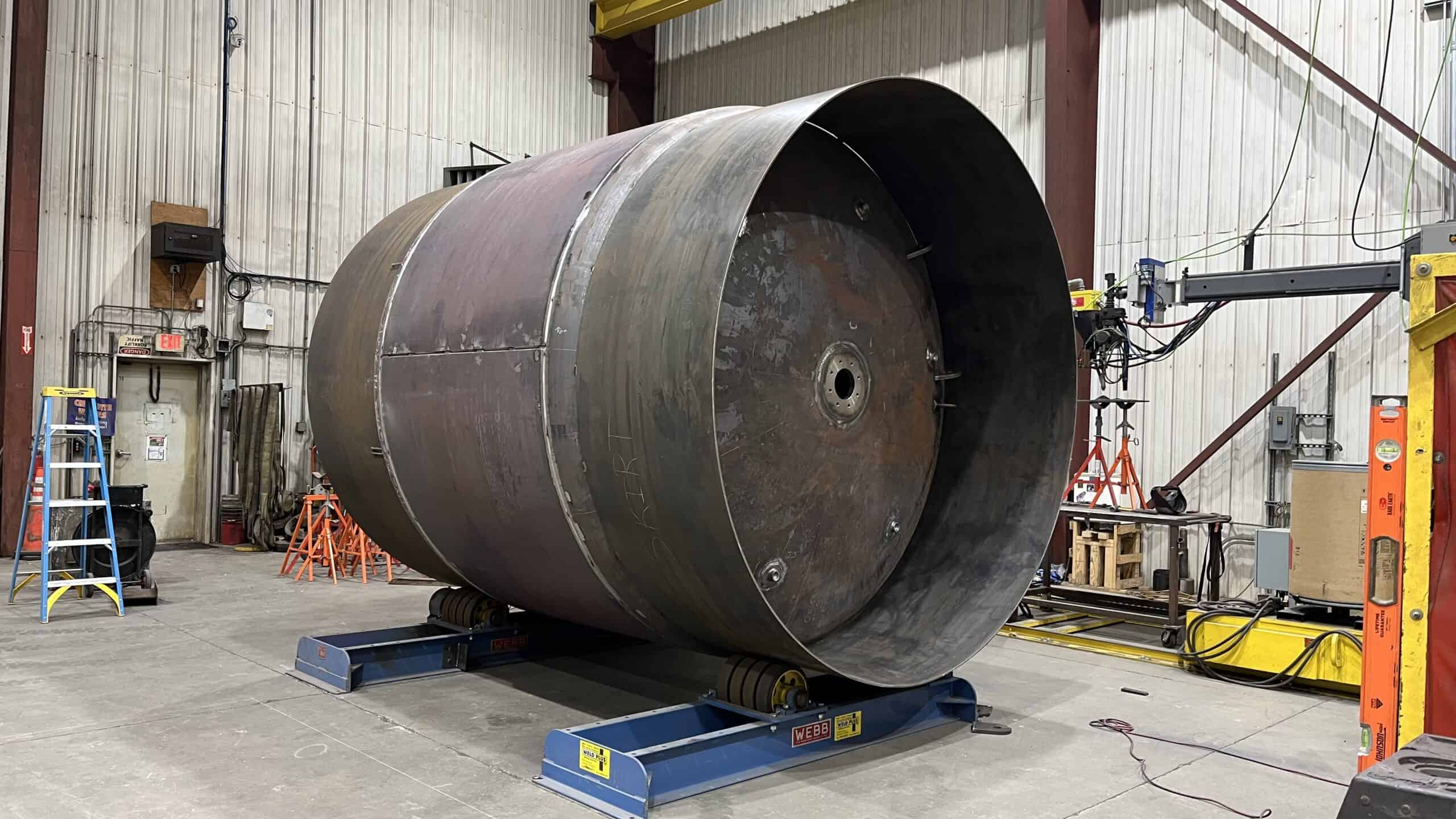
Our SAW machine is fully integrated with a heavy-duty gantry and a set of synchronized turning rollers. When working on a cylindrical structure, the rollers rotate the piece at a precise, programmed speed. Simultaneously, the gantry positions the welding head with pinpoint accuracy. This automated synchronization allows the machine to perform continuous weld passes along extensive joints without manual intervention.
Driving Efficiency and Repeatable Quality
The primary advantage of our automated SAW system is its capacity to run larger diameter wire compared to standard semi-automatic welding processes. This capability translates to exceptional deposition rates, allowing us to lay down large volumes of weld metal rapidly and efficiently.
Because the system operates on a continuous rotation using the gantry and rollers, it reduces the number of starts and stops required during a weld. Every start and stop in a traditional welding process introduces a potential weak point or defect in the joint such as a cold lap at a stop or incomplete fusion at a restart. By maintaining a continuous pass, our SAW machine eliminates these vulnerabilities.
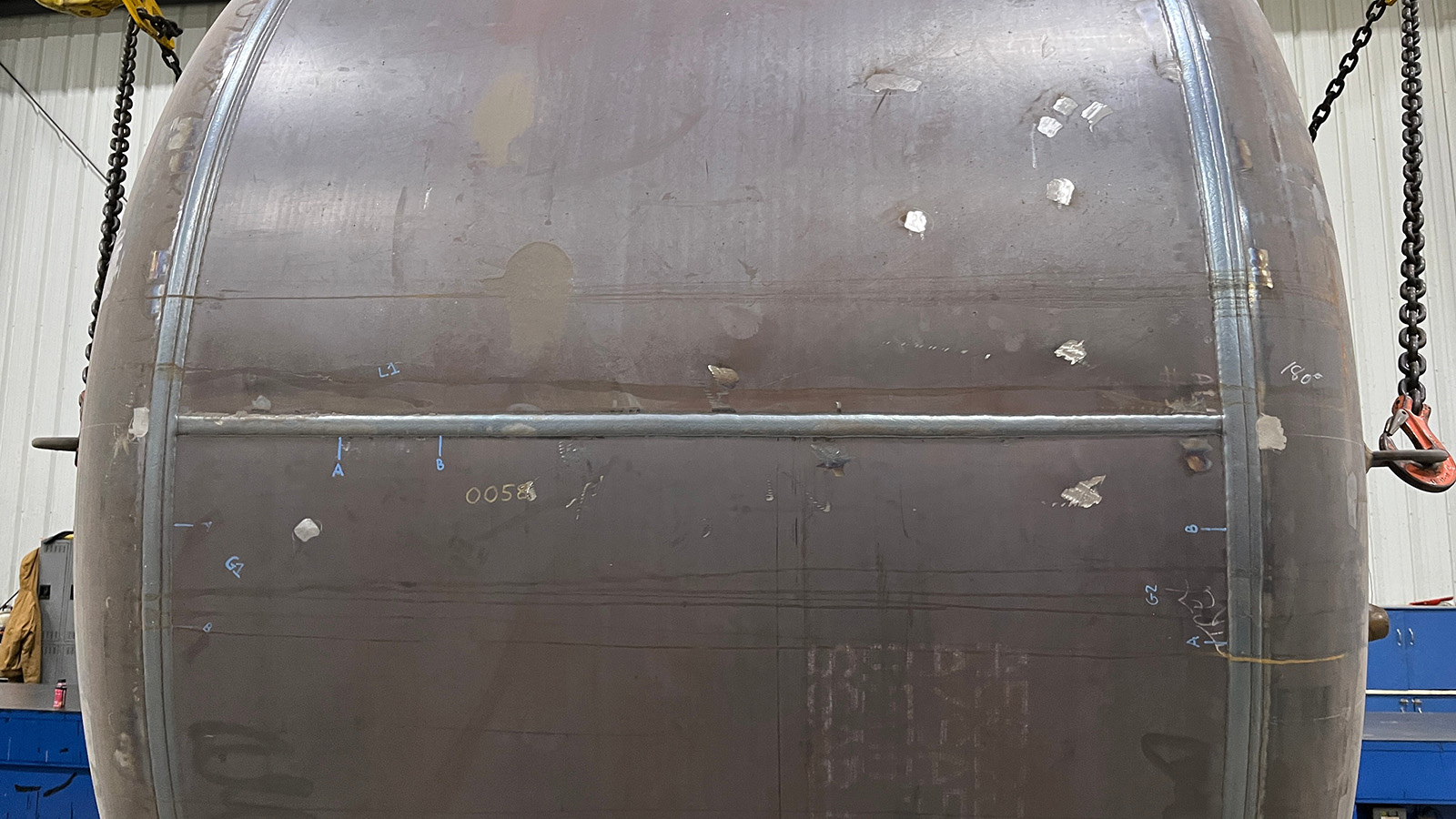
Within our fabrication sequence, shell sections are fitted to heads while maintaining a controlled weld gap. Root passes are completed manually by ASME-certified welders, after which the longitudinal and circumferential cover passes are welded using the sub arc system. This combination of skilled manual execution and mechanized welding ensures optimal joint performance.
Mechanized control of travel speed, voltage, and wire feed enables consistent penetration along the full weld length, resulting in repeatable weld quality and uniform metallurgical properties throughout the joint that manual processes simply cannot match.
Applications in Heavy Plate and Tank Fabrication
The high deposition rates and deep penetration of the SAW process make it well-suited for heavy plate applications. When constructing a pressure-retaining tank vessel, the integrity of full penetration metal joints is non-negotiable, regardless of thickness.
Our automated SAW system is specifically optimized for high-capacity tank fabrication. Whether we are rolling and welding thick carbon steel for chemical processing or utilizing high-grade stainless steel to prevent corrosion in food and beverage applications, the SAW process easily accommodates the heavy materials required. The system flawlessly handles the longitudinal seams and circumferential welds necessary to assemble large storage tanks, ensuring that the structures remain leak-proof and structurally sound under extreme pressure.
 Partner With Us for Your Next Manufacturing Project
The integration of automated submerged arc welding is just one example of our commitment to advanced fabrication practices. By investing in process control and automation, we reduce production times, minimize the margin for error, and deliver a final product engineered for decades of reliable performance.
If your next project requires robust engineering and flawless execution, our team is equipped to deliver. Contact us to discuss how our custom fabrication services can help bring your heavy plate and storage tank designs into operation.